
Simplifying MIPS Reporting Through Specialty-Focused Performance Pathways
MIPS Value Pathways (MVPs) are a reporting option under the Medicare Quality Payment Program (QPP) that organizes selected MIPS measures and activities around a specific medical specialty or clinical condition.
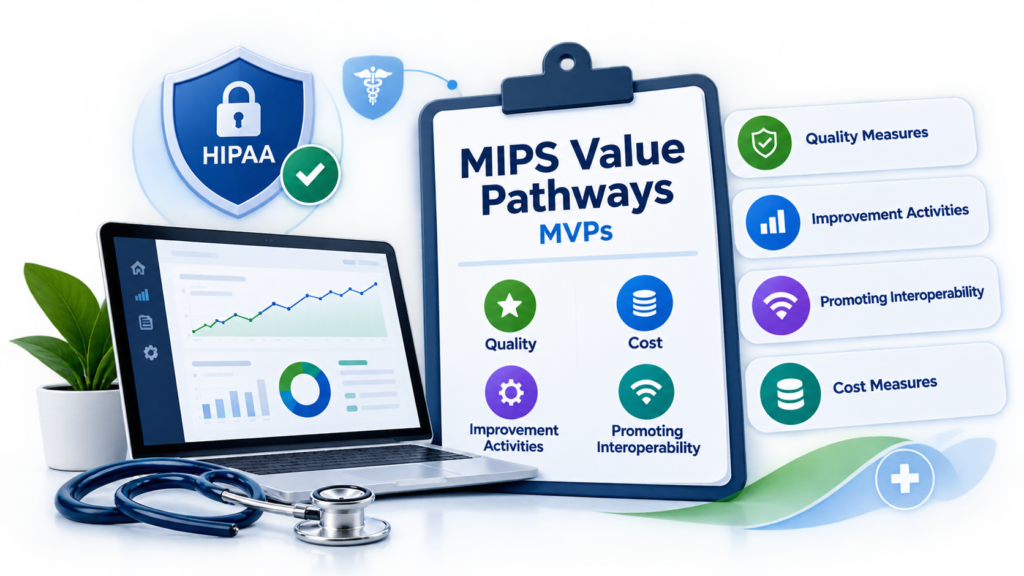
What Are MIPS Value Pathways?
MIPS Value Pathways (MVPs) are a reporting option under the Medicare Quality Payment Program (QPP) that organizes selected MIPS measures and activities around a specific medical specialty or clinical condition.
MVPs provide a more connected approach to performance measurement by grouping relevant quality measures, improvement activities, and other MIPS requirements around a clinician’s specialty or area of care.
MVPs are part of the Quality Payment Program (QPP), which includes:
- Merit-based Incentive Payment System (MIPS)
- Advanced Alternative Payment Models (Advanced APMs)
Key Benefits of MVPs
- Specialty-focused reporting
- More focused measure selection
- Connected performance feedback
- Reduced reporting complexity
- Preparing for future MIPS changes
How Do MIPS Value Pathways Work?
An MVP organizes applicable MIPS reporting requirements around a defined clinical focus.
Depending on the selected MVP and reporting circumstances, clinicians may report applicable measures and activities across the MIPS framework.
Quality
The Quality category evaluates performance using applicable quality measures. For MVP reporting, the specific quality measures available depend on the selected MVP. CMS's 2026 MVP materials specify the applicable measures and reporting requirements for each individual MVP.
Improvement Activities
MVP participants must perform applicable improvement activities available within their selected MVP. CMS states that beginning in 2025, all MVP participants, including small practices, must perform one improvement activity from those available within their selected MVP.
Promoting Interoperability
Promoting Interoperability is part of the foundational layer of MVP reporting. CMS states that the Promoting Interoperability requirements under MVPs are the same as those under traditional MIPS, subject to applicable reweighting, clinician type, special status, or approved hardship exceptions.
Cost
Cost performance is calculated by CMS using Medicare claims data. Clinicians generally do not submit separate data for the Cost category when reporting an MVP. CMS calculates performance on applicable cost measures using available Medicare claims data and established case minimum requirements.
MIPS Value Pathways vs. Traditional MIPS
| Feature | Traditional MIPS | MIPS Value Pathways (MVPs) |
|---|---|---|
| Reporting Option | Original MIPS option | Structured MIPS option |
| Measure Selection | Broader measure selection | Specialty/condition-focused measures |
| Measure Grouping | Selected within traditional MIPS requirements | Grouped within a specific MVP |
| Performance Categories | Applies across MIPS categories | Connects categories through an MVP framework |
| Participation Options | Individual, group, subgroup, or APM Entity | Individual, group, subgroup, or APM Entity (depending on circumstances) |
Who Can Report an MVP?
CMS provides several MVP participation options:
Individual
A single eligible clinician can report an MVP individually.
Group
Eligible clinicians can participate through a group where applicable.
Subgroup
A defined subgroup within a practice can report an MVP.
APM Entity
An APM Entity can participate in an MVP where applicable.
2026 MIPS Value Pathways
CMS has finalized multiple MVPs for the 2026 performance year, covering a range of medical specialties and clinical conditions.
- Adopting Best Practices and Promoting Patient Safety within Emergency Medicine
- Advancing Cancer Care
- Advancing Care for Heart Disease
- Advancing Rheumatology Patient Care
- Complete Ophthalmologic Care
- Coordinating Stroke Care to Promote Prevention and Cultivate Positive Outcomes
- Dermatological Care
- Diagnostic Radiology
- Focusing on Women’s Health
- Gastroenterology Care
- Improving Care for Lower Extremity Joint Repair
- Interventional Radiology
- Neuropsychology
- Optimal Care for Kidney Health
- Optimal Care for Patients with Urologic Conditions
- Prevention and Treatment of Infectious Disorders Including Hepatitis C and HIV
- Pulmonology Care
- Quality Care for Patients with Neurological Conditions
- Quality Care for the Treatment of Ear, Nose, and Throat Disorders
- Quality Care in Mental Health and Substance Use Disorders
- Rehabilitative Support for Musculoskeletal Care
- Surgical Care
- Value in Primary Care
- Vascular Surgery
MIPS Value Pathways Measures
Measures included in an MVP are determined by CMS for that performance year.
Quality Measures
Evaluate specific aspects of quality and performance.
Improvement Activities
Support practice improvement and clinical processes.
Promoting Interoperability
Use of certified EHR technology and health information exchange.
Cost Measures
Calculated by CMS using Medicare claims data.
How MIPS Value Pathways Quality Reporting Works
For each MVP, CMS establishes applicable quality reporting requirements.
- Report 4 quality measures (At least 1 must be an outcome measure).
- Collect data for the 12-month performance period (January 1 – December 31, 2026).
- Meet case minimum and data completeness requirements.
- Follow the specific requirements for the selected MVP.
- Use the official CMS/QPP specifications for your MVP and performance year.
MIPS Value Pathways Measures
Measures included in an MVP are determined by CMS for that performance year.
MVPs and Small Practices
CMS provides specific flexibilities for small practices, including:
- Report all Medicare Part B claims measures (even if fewer than four).
- Additional scoring flexibilities and bonus points.
- Multispecialty small practices can report as a group (subgroups optional).
MVP Reporting for Multispecialty Practices
Beginning in 2026, non-small multispecialty groups must report as subgroups or individuals.
Key information to review:
- TIN, NPI, specialty, clinician participation
- MVP eligibility and subgroup structure
- Reporting method
The MIPS Value Pathways Reporting Process
- Check MIPS eligibility (use QPP Participation Status tool).
- Identify the applicable MVP.
- Review MVP measures and activities.
- Determine the reporting structure.
- Collect required data (Jan 1 – Dec 31, 2026).
- Submit applicable data through the right channel.
- Review performance (CMS calculates cost using claims data).
How NexcureMD Supports MIPS Value Pathways
NexcureMD helps healthcare practices organize their MIPS Value Pathways reporting workflow around CMS/QPP requirements.
MVP Selection Support
Identify the right MVP based on specialty and eligibility.
Quality Measure Support
Understand and organize applicable measures.
Improvement Activity Support
Find and document applicable activities.
Promoting Interoperability Support
Organize EHR and HI requirements.
Reporting Preparation
Prepare data and documentation before submission.
Performance-Year Tracking
Track requirements throughout the year.
Documentation & Compliance Support
Maintain organized documentation.
MIPS Value Pathways FAQs
What does MVP stand for in MIPS?
Are MVPs part of the Quality Payment Program?
Are MVPs mandatory?
Can a small practice report an MVP?
Can a clinician report more than one MVP?
Does CMS calculate the Cost category?
How long is the MIPS performance period?
Where can I check my MIPS eligibility?
Navigate MIPS Value Pathways With a Structured Process
MIPS Value Pathways can provide a more focused approach to MIPS reporting by connecting measures and activities to specific specialties and clinical conditions.
NexcureMD works with healthcare practices to organize their applicable MIPS Value Pathways requirements, quality measures, improvement activities, Promoting Interoperability requirements, documentation, and reporting workflow based on the applicable CMS/QPP requirements.
Ready to simplify your MIPS reporting process?
